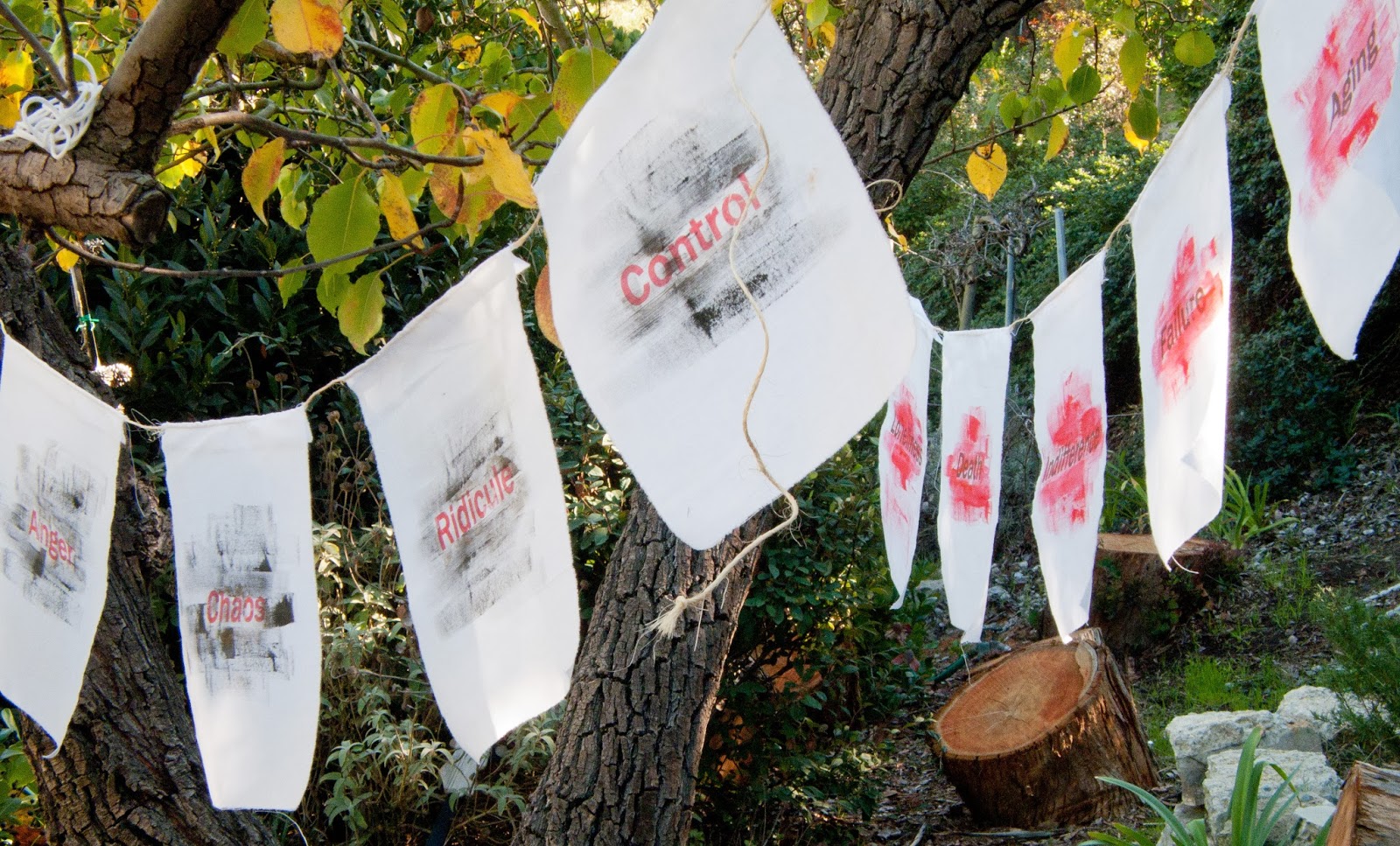
These are some things I'm experimenting with as I reflect on the identity as a performance, as a multi-layered or fragmented structure, or as a contingent experience.
The adjacent possible is a kind of shadow future, hovering on the edges of the present state of things, a map of all the ways in which the present can reinvent itself.
Sunday, March 2, 2014
Wednesday, February 26, 2014
The Challenge of Politically Themed Work
During the month of February I have been studying the work of Doris Salcedo. She is a Columbian artist whose work has focused on the political situation in Columbia. During years of civil unrest countless individuals have "disappeared" through the action of the government and the military. Salcedo has created installations that memorialize those who vanished with no words to their families and with no information about where and how they died and where their remains are buried.
Salcedo has taken this horrific subject matter and created visually eloquent metaphors that honor the memory of these individuals, as well as a universal sense of loss we all must face when a loved one dies.
As I studied Salcedo's work I am struck by the challenge of addressing political themes in art. It is no small task to evoke sadness and commemoration without descending to a voyeuristic exploitation of the violence or a didactic lesson on political injustice. Studying her work as well as reading "Of What We Cannot Speak" by Mieka Bal has opened my eyes to how important political art is, but also how easily it can become propaganda or simple opinion.
It is a daunting task to take my concerns about life in America and create a piece of art that speaks volumes in a glance and/or stimulates thoughtful discussion. I will continue to study Doris Salcedo's work and other political art in order to discover how to synthesize ideas and events in a similarly poetic manner.
Salcedo has taken this horrific subject matter and created visually eloquent metaphors that honor the memory of these individuals, as well as a universal sense of loss we all must face when a loved one dies.
As I studied Salcedo's work I am struck by the challenge of addressing political themes in art. It is no small task to evoke sadness and commemoration without descending to a voyeuristic exploitation of the violence or a didactic lesson on political injustice. Studying her work as well as reading "Of What We Cannot Speak" by Mieka Bal has opened my eyes to how important political art is, but also how easily it can become propaganda or simple opinion.
It is a daunting task to take my concerns about life in America and create a piece of art that speaks volumes in a glance and/or stimulates thoughtful discussion. I will continue to study Doris Salcedo's work and other political art in order to discover how to synthesize ideas and events in a similarly poetic manner.
Doris Salcedo, "Atrabiliarios,"
detail, 1992-93. Shoes, animal fiber, and surgical thread.
Alexander and Bonin,
New York.
In this piece "shoes of disappeared people (mostly women but also a few men) are buried in niches in the gallery wall, and half hidden in by animal skins roughly stitched to the wall". Mieka Bal, from Doris Salcedo Plegaria Muda, p. 82
Doris Salcedo, "Plegaria Muda", detail, 2008-2010. Wood, mineral compound, metal and grass. Alexander and Bonin, New York.
"Plegaria Muda seeks to confront us with repressed, unfathomed grief, and with violent death when it is reduced to its total insignificance and forms part of a silenced reality as a strategy of war.
It is also a response to a particular event that took place in Columbia between 2003 and 2009 in which approximately 1500 young people from deprived areas were murdered by the Columbian army for no apparent reason. It was clear, however, that the Columbian government had implemented a system of incentives and rewards for the army if they could prove that a greater number of guerrillas had been killed in combat" Doris Salcedo from Doris Salcedo Plageria Muda, p. 25.
Wednesday, February 12, 2014
February 2014
This month my studio work is focusing on the use of the silhouette. I have found new and previously used images and am preparing them to use both as fused fabric elements and digital images to print directly on fabric. I have contacted several print shops to find a sheer, white fabric that can be printed with digital imagery that I create. In the past I have cut and sewn life-sized silhouettes on fabric curtains, but this process is time consuming and the results are inconsistent. Finding a print shop to do this will open up many possibilities for me to create text and images on this semi-transparent fabric.
I have been examining the use of stitching and silhouettes in the fabric lined frames. I am working to create a story in each piece that is indicated by the attitudes of the figures, the pattern of the stitching and the frame itself. I am looking for ways to activate the frame more as a part of the entire composition.
Three-dimensional construction is very interesting to me, and I'm looking for ways to float the transparent fabric in space and contain figures within it. I have several fabric figures that have been dipped in wax. I'm examining how to mount these on or within fabric structures.
As I manipulate the layers of fabric, I'm also using other translucent materials, such as vellum, that I can embed images within as well as superimpose drawings upon.
In all this work the idea of the human being struggling with identity, belonging, conflict, and emotion drives the imagery and materials.
For my academic research I am focusing on the idea of the "trace" as evidence of memory, the passage of time and socio-political concerns. The work of Doris Salcedo, Gabriel Orozco and Felix Gonzalez-Torres explores these ideas. These concepts reflect on personal as well as political issues that I hope to express in my own work.
I have been examining the use of stitching and silhouettes in the fabric lined frames. I am working to create a story in each piece that is indicated by the attitudes of the figures, the pattern of the stitching and the frame itself. I am looking for ways to activate the frame more as a part of the entire composition.
Three-dimensional construction is very interesting to me, and I'm looking for ways to float the transparent fabric in space and contain figures within it. I have several fabric figures that have been dipped in wax. I'm examining how to mount these on or within fabric structures.
As I manipulate the layers of fabric, I'm also using other translucent materials, such as vellum, that I can embed images within as well as superimpose drawings upon.
In all this work the idea of the human being struggling with identity, belonging, conflict, and emotion drives the imagery and materials.
For my academic research I am focusing on the idea of the "trace" as evidence of memory, the passage of time and socio-political concerns. The work of Doris Salcedo, Gabriel Orozco and Felix Gonzalez-Torres explores these ideas. These concepts reflect on personal as well as political issues that I hope to express in my own work.
Sunday, February 2, 2014
January 2014 Residency Summary
Ann Olsen
Group Two, Spring 2014
Residency Summary
Advisor: Matt Keegan
My work is now
following two separate but related trajectories. In both, I will continue to
use white, translucent fabric and hand or machine stitching. In one I will
continue to use silhouetted figures; in the other I will use text. These lines
of inquiry focus on identity and the multiple structures of the self and its
relationship to others and the world. The use of questions is my way of
exploring the opposing choices and opinions that create a kind of schizophrenia
in American cultural identity. The stitched lines and use of fabric show the
connection to past, present and future and also trigger a universal tactile
response. I will continue to develop this inquiry and stay focused on creating
personal imagery that conveys my ideas more clearly. In the use of text I need
to refine and re-examine the questions, simplifying yet creating an intriguing
field of inquiry for the viewer.
Critique Notes
In the use of text:
·
Explore more specific relevant and less
rhetorical questions
·
Consider the design of the text, the font as
part of the message
·
Try to find different levels of meaning, words
as contradictions
·
Find experimental questions
·
Play with the questions: juxtapose, reverse, create
ambiguity and/or tension
·
Consider why I am asking these questions, look
for questions inside the questions
·
Look at how artists are using text now compared
to ten or more years ago.
·
Separate the text pieces from imagery. Text has
more impact on its own.
·
The “prayer flag” installation is stalled by the
awkwardness of the questions: Can it be resolved by refining the text or is
there another possibility?
For the small framed pieces:
·
Single figures more powerful than multiples
·
Let the pieces converse with each other
·
Play with the stitching
·
Integrate the frame more into the piece, consider
how the frame and the figure communicate together
·
Consider no frame, how to structure that?
·
Change to a horizontal orientation
·
Create additional personal imagery to tell the
story
·
Consider the power in the image and how it
speaks
For the “curtain” piece:
·
Re-think the scale make it much bigger
·
Make the layers count for the construction of
the piece and its ideas
·
Make the ideas more apparent: veiling,
shrouding, hiding, remembering and forgetting, illusion, denial
The critiques
during the residency as well as the other activities have given me new ways to
approach this work. I will look for additional expressive silhouettes and use
them in both frames and in three dimensional constructions. I plan to find a
way to print life-size figures on sheer material that creates a more
interactive structure. Examining the use of text will be my greatest challenge.
I have an idea about font styles and meaning that I plan to experiment with. I
will continue to experiment with the “prayer flags” concept and what it says.
These are some of
the artists I will be looking at:
·
Doris Salcedo
·
Gabriel Orozco
·
Liam Gillick
·
Anna Von Martens
·
Sister Corita Kent
·
Julie Ault
·
Tony Oursler
·
Sophie Calle
·
Shirin Neshat
·
Elaine Reichek
·
Ambreen Butt
·
Lesley Dill
·
Doh Ho Suh
These are some books and articles I’ll be looking at:
· Gregg Bordowitz, Volition
·
T. S. Elliot, Four Quartets
·
Carl Jung, Man
and His Symbols
·
Adrian Piper, Rationality and the Structure of the Self
·
Wendy Richmond, Art Without Compromise
·
Rosalind Kraus, Sculpture in the Expanded Field
·
Rebecca
Twist, PhD, Fiber
Arts Now
· Annin Barrett, A Stitch in Time: New Embroidery,
Old Fabric, Changing Values. (2008). Textile Society of America Symposium
·
Elaine Reichek and Beth Handler, MOMA Projects 67: Elaine Reichek an
Interview with Beth Handler
· Elizabeth A. Smith et al, LIFE DEATH LOVE HATE PLEASURE PAIN Selected
works from the Museum of Contemporary Art Chicago, Collection
· Mieka Bal, Of
What One Cannot Speak Doris Salcedo’s Political Art
·
Bal,
Borchardt-Hume, Gilroy, Weizman, Doris
Salcedo Shibboleth
Saturday, January 18, 2014
Thursday, December 12, 2013
New work completed from June to December 2013
In June, I began working on a series of fabric lined frames with silhouettes of figures and hand stitching.
These are the most recently completed pieces. I apologize for the image quality. I have inadequate space and light to photograph my work. I am working on improving it.
Alienation
Bad Energy
Last Performance
Transcendance
Anger in Me
I have also been working on a series of "flags" that feature questions that continue to plague me about life in our culture. Based on the concept of Tibetan prayer flags, they are not prayers but questions and concepts that seem to be searching for attention. Originally I wanted to make one flag a day to create a mass of questions, but I ended up making fewer with more thoughtful compositions.
"No Right Answers".
The last piece I have been working on, is an old chair that I have inscribed with words and thoughts about oppression: the oppressed vs. the oppressor. The idea is the trap of oppression where the oppressed, once liberated, may in turn become the oppressor. This cycle of violence seems to continue in the world. In American culture I see this played out in our worship of wealth and accumulation that equals power and domination. This piece is still unresolved. I'm not sure the materials and the message are working together. I experimented with wrapping the chair with wire or fabric and considered several versions of a cushion for the chair. I will continue to experiment with this piece. It may be more of "sketchbook" for these ideas.
Monday, December 9, 2013
In my class in digital media, our assignment title was "Follies of Technology". Here is a video I made that questions our ability to integrate technology and modern life. This is my first attempt to use Adobe Premier for video editing. I wanted to animate the still images by repeating them in short bursts and jumping back and forth between them.
Subscribe to:
Posts (Atom)